
Your Brand Is Telling One Story
Every post, page, email, and interaction is either adding to it, or breaking it.
In this chapter
- Three Words Can Carry an Entire Story
- Stories Don’t Stand Alone. They Stack.
- Your Brain Remembers Meaning, Not More
- Look at What Each Moment Reinforces
- Busy Brands Build Moments. Strong Brands Build Meaning.
- Stop Adding. Start Strengthening the Stack.
- Everything Adds to the Story, or Breaks It
One of the most memorable stories I’ve read was 3 words and a picture.
How is that even possible?
That’s what we’re uncovering today.
For my 50th birthday, my husband bought me a purse.
Not just any purse.
It was a splurge, something I’d never buy for myself.
I love good purses.
The craftsmanship.
The feel.
The way a great one starts conversations.
The way they feel fun and well made and classy all at the same time.
(The things I hope I am, you could say. :))
I’m also very good at talking myself out of things.
But that day… I went to unbox the gift and the minute I saw the logo on the box, I knew.
I met my husband’s smiling eyes, and almost accused him,
“You didn’t.”
It was a Coach purse. This one in fact:
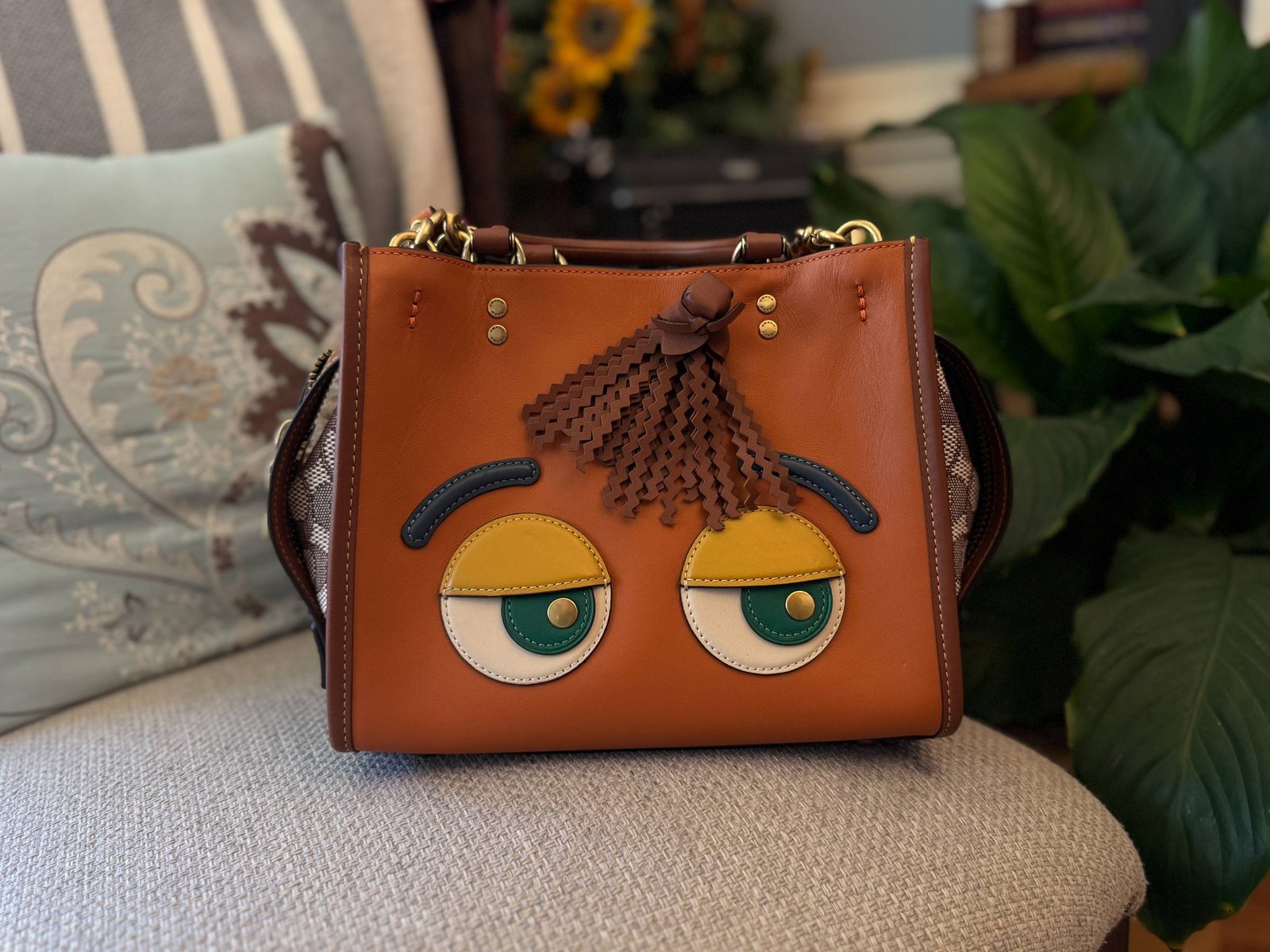
I’d seen it. Fallen in love with. Gushed at least twice about it. (And yes, it has a face.)
At that point, I’d been a Coach fan for years. I owned one purse and it was the go-to bag whenever we went out, whenever I wanted to level up how I looked and felt.
And this one..it was just so. much. fun.
And this gift wasn’t just a splurge. It was recognition from the man I love. He knew it wasn’t just about the purse.
It was about identity.
About seeing something that brought me joy, something that felt like me, and he translated that story into action, without me ever asking for it.
It’s one of my favorite things I own.
At the time, I didn’t think of it as a story.
I just knew I felt deeply seen.
This wasn’t the first time Coach had done that.
(Well, they had help this time.)
And this is where it gets interesting.
Because before this gift, there was another moment — back in 2018, actually, that quietly shifted how I thought about storytelling altogether.
It shouldn’t have worked. But it did.
And it told me something about what stories actually are,
and why some of them stay with us for years.
Three Words Can Carry an Entire Story
Coach is having a bit of a comeback moment right now.
And first — no, this issue is not about purses.
Or fashion. (Seriously. I’m the girl who lives in leggings.)
It is about storytelling.
Whether you’re a purse lover (hi), love someone who is, or genuinely could not care less where your keys and wallet go (which honestly… where do they go?), Coach is giving a masterclass right now in a few things many brands get wrong.
Because when you look at what they’re doing, it all feels separate.
Their designs carry a sense of nostalgia without feeling dated — something Gen Z and maybe all of us need right now.
Their stores are built to invite you in while still making you feel premium just for being there.
The pop-ups they’ve been creating lean into familiarity, experience, and self-expression.
Each of those things looks like its own decision.
It’s own thing.
And that’s the illusion.
None of it is focused on impressing you with how (insert your favorite lofty adjective here) they are.
Nope – it’s all doing the same job:
Signaling recognition.
Yes, Coach sells purses. That’s their product.
But what they’re offering isn’t a collection of disconnected experiences.
It’s a single story– told everywhere you meet them.
Back in 2018, long before anyone was talking about the Coach comeback, I saw an ad on Facebook that stopped me cold.
I even screenshotted it. One image. Three words.
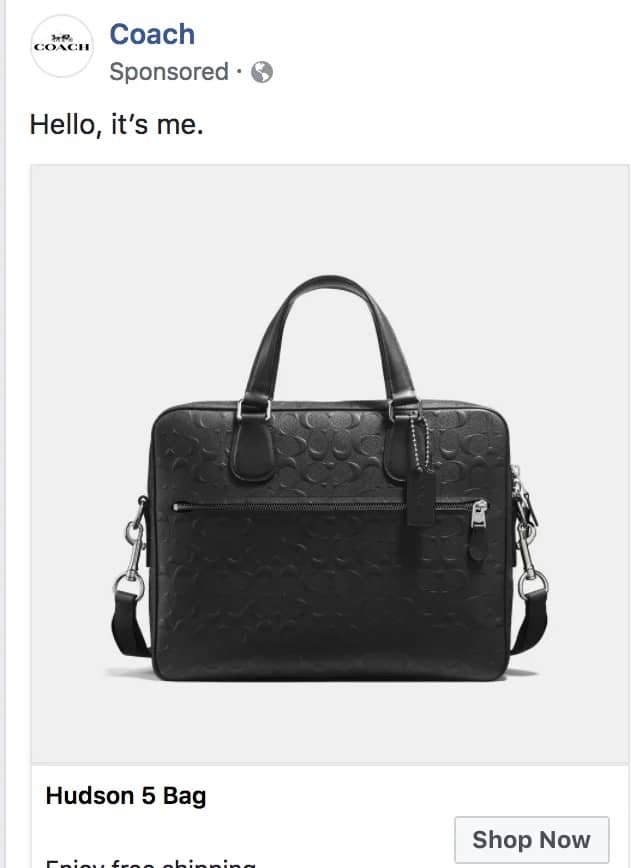
The minute I saw it, I felt it. It felt oddly personal. Oddly connected. And that’s not usually the kind of reaction I have to ads. But this one landed.
What struck me later wasn’t that the ad was short, it was that it didn’t try to do all the things.
It wasn’t flashy.
It wasn’t a list of 28 reasons to buy.
There was no backstory. No justification. No explanation.
No attempt to tell me who Coach was or why I should care.
They knew I already did.
Yes, I had visited the website, so it’s a retargeting ad. But you and I have both seen retargeting ads that, well, frankly stink.
This one… recognized me. In three words and a picture.
It shifted how I thought about how brands use storytelling.
It wasn’t about a single story. It was about a story that built through every moment, every connection point. Every interaction had quietly taught me how to feel about the brand.
That’s why this worked.
That’s when I stopped seeing storytelling as something brands tell, and started seeing it as something you build.
(If you’d like a deeper breakdown into why Coach’s comeback is holding, I wrote a full brand analysis here → Coach Isn’t Back Because of a Bag.)
Stories Don’t Stand Alone. They Stack.
We tend to treat stories like little moments on an island.
A campaign.
An ad.
A post.
A launch.
Something you create, release, and then move on from.
But the stories that build a brand don’t work one isolated item at a time.
Rule #1: Stories don’t work in isolation. They stack.
That Coach ad didn’t work because it was clever or minimal or emotionally resonate on its own. On it’s own, it would have just been…short.
It worked because it matched everything that came before it — the product, the stories, the tone, the way the brand had already taught me to feel.
When I saw those three words, they didn’t introduce a new story. They confirmed an existing one.
That’s how trust gets built.
Through repetition that feels intentional.
Through consistency that feels human.
But when that stack breaks, trust doesn’t explode like a big disaster movie scene.
It erodes. That brings us to:
Rule #2: Stories don’t fail in the moment. They fail when nothing sticks.
You don’t lose people because something went dramatically wrong.
You lose them because nothing lingered.
That’s why one of my favorite comments to get on a post is “this has me thinking.” (Seriously, if you leave those, I’ll share my “I love you all” gifs. It makes me so happy.)
Because when a story lands, it keeps working after the moment is over.
After they’ve doom scrolled 10 more times.
After they’ve closed the tab and jumped into eight zoom calls in one day.
After they’ve moved on to other things.
If it sticks, it changes them — sometimes in a tiny way.
A thought.
An action.
A pause.
A feeling.
And there’s a very real reason our brains hold onto some stories…
and let others disappear.
Your Brain Remembers Meaning, Not More
Here’s the part that makes this feel like magic, even though it isn’t. (Well, the brain is kind of magical.)
Our brains aren’t wired to remember information.
They’re wired to remember meaning.
Facts pass on through.
Feelings stay.
That’s because memory isn’t filed by accuracy, it’s filed by emotional relevance.
The neuroscience peeps call this emotional tagging. When something creates a small emotional shift — good or bad— your brain tags it. If you created emotional recognition, familiarity or a-ha’s? Your brain says Yup, worth keeping.
That’s why stories that stack work better than stories that shout. Each moment builds on the emotional truth of the last one, and your brain stops treating it like noise and starts recognizing context that matters to you.
This is also why nothing sticking is such a problem.
When there’s no emotional residue, there’s nothing for the brain to hold on. Cognitive science calls this memory decay. If meaning isn’t reinforced, it fades. Fast.
We want sticky.
We want sticky stories that stack.
(Say that five times fast.)
When meaning repeats, it moves from short-term awareness into long-term memory, and that’s where identity, trust, and belonging actually live.
That’s the difference between a story people consume (and forget),
and a story that quietly becomes part of how they see and who they are.
What this changed for me
That 3 word ad changed how I looked at marketing, period.
It’s where I realized something important: storytelling for brands and businesses isn’t different from storytelling in fiction. Not really. In both cases, story isn’t something you produce. It’s something you maintain.
I’ve seen this as
It stopped being, “What story am I telling here?”,
And became, “What am I reinforcing every time someone encounters this?”
It changed how I look at everything. An email isn’t just an email. A landing page isn’t just a landing page.
A post isn’t just a post. They are all part of a stack.
Meaning sticks.
Noise disappears.
It’s not about more. It’s not about bigger. It’s about building a story that holds everywhere your audience has a chance to choose.
Look at What Each Moment Reinforces
Stories aren’t rare. They’re constant (and only becoming more so as we see companies hire “storytellers.”) The only difference between a storyteller and someone who says “I’m not a storyteller” isn’t talent or craft or output.
It’s intention.
Storytellers notice on purpose.
They notice how a moment feels. What it reinforces. Whether it adds to the stack, or quietly chips away at it.
Stories can be three words. Three pages. Three hundred pages.
Length doesn’t make something a story. Transfer does.
Don’t look for better stories to create. Instead, look at the moments you already have where your audience makes a choice (your emails, pages, conversions, posts…) and ask what they’re reinforcing. You’ll see patterns fast.
Busy Brands Build Moments. Strong Brands Build Meaning.
Brands stall here because they’re optimizing moments instead of building (and maintaining) meaning.
Here’s what that actually looks like:
The sales team wants messaging that converts now. So the landing page gets rewritten with benefit-focused copy that performs well, but it doesn’t sound like anything else the brand says. Customers get confused.
The social media manager creates content that gets engagement, but it’s chasing trends rather than reinforcing who you are.
A rebrand “modernizes” but long-time customers suddenly don’t recognize the brand anymore. (We’ve seen this a few times in recent news.)
I’ve seen very expensive “moments” in companies I worked for where leadership pushed a personal preference over the consistent narrative, or a campaign got rushed out to hit a goal. They were story breaks that took months to repair, not because they were disasters, but because nothing about them added to the stack.
Each piece we create often gets evaluated on its own:
- Did this post perform?
- Did that campaign convert?
- Did this page explain one thing clearly?
All worthy metrics, but collectively they miss the most important one.
What story is this adding to the stack?
And is it the story we want to tell?
When brands or teams work moment-to-moment, they end up with content that technically works… but doesn’t accumulate. Nothing is wrong enough to fix. Nothing is strong enough to stick.
So the brand stays busy — but flat.
And the biggest stall of all? More.
More content.
More explanation. More campaigns.
More effort, without more meaning.
Stop Adding. Start Strengthening the Stack.
My challenge to you this week (and it might feel uncomfortable):
Look at your plan for this week.
What more are you creating from scratch?
Now pause.
On all of it.
Before you add anything new, look at what’s already telling a story. The posts, pages, emails, ideas, conversations — the things your audience already encounters.
Ask one simple question:
What story is this adding to the stack?
Not what it explains. Or promotes. What it adds to the stack.
If something feels off, don’t rush to replace it with more. Adjust it so it aligns. Make the story clearer. Make it more you.
Because the fastest way to build a story that sticks isn’t to say more.
It’s to make sure what you’re already saying is working together.
Everything Adds to the Story, or Breaks It
Stories that stick don’t say more.
They make everything work together.
The Cold Brand Read · Free to start
Before you fix the wrong thing, let me read what’s there.
Send me your site. I’ll show you what it’s saying about you, and what it’s leaving out.
Or take the Story Compass quiz