The Insight Bridge Method: How to Turn Complex Ideas Into Clear Moments
If you’ve ever tried to explain something complex and watched people’s eyes glaze over, you know this problem.
You understand the idea clearly. You explain the system, the strategy, or the technology behind it And somehow the explanation makes it less clear.
This happens constantly with expert knowledge.
Founders explain their products.
Consultants explain their frameworks.
Technical teams explain their infrastructure.
The explanation is accurate, but the audience still struggles to see why it matters. The problem usually isn’t the idea. It’s that the explanation never crosses the bridge between knowledge and experience.
People don’t understand ideas when we explain them. They understand ideas when they can see a moment where the idea matters.
That shift—from explanation to experience—is what I call the Insight Bridge. Instead of starting with the explanation, the Insight Bridge starts with a moment the audience can recognize.
Then the insight appears inside that moment. Once you see how it works, complex ideas suddenly become much easier to communicate.
If you want to see how this pattern shows up in brands, movies, and books, read the companion article: → Why Great Stories Turn Expertise Into Insight
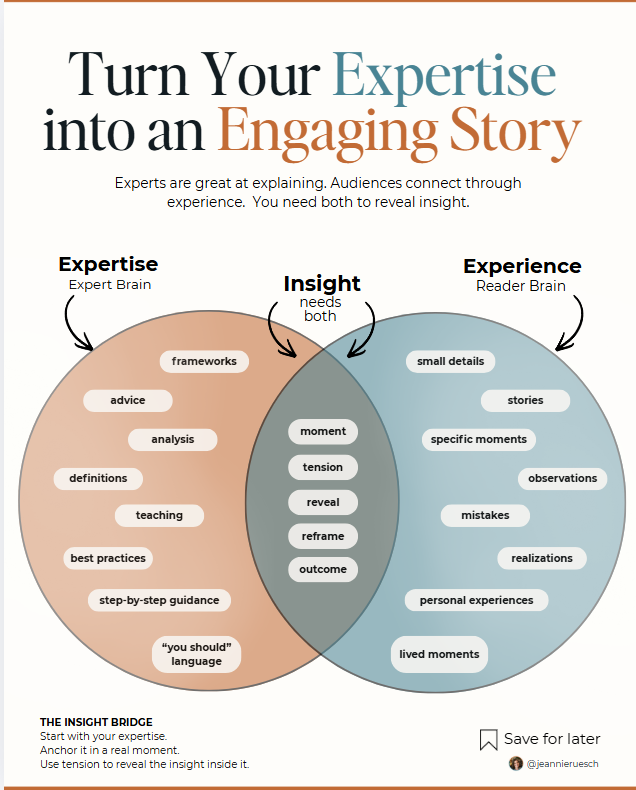
1. Start with the expertise
Begin with the idea you want to teach.
This is the part experts naturally focus on:
- a framework
- a best practice
- a system
- a definition
For example, a company might say:
“Our platform uses AI-powered infrastructure to improve workflows and automate repetitive tasks.”
That statement might be accurate, but it’s still abstract. Most audiences don’t have a mental picture for “AI-powered infrastructure.”
Don’t rewrite the idea yet. First, pull out what the sentence is really trying to say. Underneath this, the company means something more like: “The product helps people get work done faster because AI is built into how it works.” Still explanation, but clearer. Now we have something we can work with.
2. Add a real moment
Now take that explanation and ask: Where would a user actually feel this?
Start adding the moment into the sentence.
“Our platform uses AI-powered infrastructure to improve workflows and automate repetitive tasks, so users can get work done faster.”
Closer, but still corporate. Now shift it again so the sentence starts to move toward an experience:
“Instead of manually sorting and routing every request, the platform handles it in the background so teams can keep moving.”
Now we can see something. A user no longer has to manually sort and route requests.
That’s a moment.
3. Add tension
A moment gets stronger when there’s friction in it. Something annoying. Something slow. Something people recognize. So now sharpen the problem.
“Instead of manually sorting and routing every request that hits your queue, our platform handles it in the background so your team doesn’t lose time triaging work.”
Better. Now the reader can feel the pain point: the queue, the triage, the lost time. But we can tighten it even more.
“A customer request comes in. Instead of sitting in a queue while someone figures out where it belongs, our platform routes it instantly in the background.”
Now we’re in a real moment. Something arrives. There’s usually a delay. In this version, the delay disappears.
That gives us tension and movement.
4. Reveal the insight
Now that the moment is clear, you can bring the expertise back in, but as the explanation for what just happened. So the sentence evolves again:
“A customer request comes in. Instead of sitting in a queue while someone figures out where it belongs, our platform routes it instantly in the background because AI is built into the system itself.”
Now the AI explanation finally matters. Why? Because the reader has already seen the problem and the outcome.
The insight is no longer abstract.
5. Reframe it into something people remember
Now compress it into the version that lands. You’re no longer trying to explain the architecture. You’re trying to explain why the user should care.
So the sentence shifts one more time:
“Your team shouldn’t have to stop and sort every request. The platform knows where it goes before the queue even builds.”
Or:
“The best AI in your platform isn’t the part you open. It’s the part already working before you ask.”
Or:
“AI matters most when your team doesn’t have to think about it at all.”
That’s the bridge. Same idea. Different form.
Remember, we started here: “Our platform uses AI-powered infrastructure to improve workflows and automate repetitive tasks.”
The shift, step by step
Start with the expertise
“Our platform uses AI-powered infrastructure to improve workflows and automate repetitive tasks.”
Clarify what it really means
“The product helps people get work done faster because AI is built into how it works.”
Add the real moment
“Instead of manually sorting and routing every request, the platform handles it in the background so teams can keep moving.”
Add tension
“A customer request comes in. Instead of sitting in a queue while someone figures out where it belongs, the platform routes it instantly in the background.”
Reveal the insight
“A customer request comes in. Instead of sitting in a queue while someone figures out where it belongs, the platform routes it instantly in the background because AI is built into the system itself.”
Reframe it into something memorable
“The best AI in your platform isn’t the part you open. It’s the part already working before you ask.”
The problem isn’t your ideas
Most experts don’t have an idea problem.
They have a translation problem.
They understand the system so well that they lead with the explanation. But the audience can’t feel the value yet, because they haven’t been given a moment to step into.
They start with the system.
The audience needs the moment.
That’s what the Insight Bridge Method solves.
It helps you take a complex idea, find the moment where it becomes real, add the tension that makes people care, and reveal the insight in a way that actually lands.
Same idea. Different shape.
And that shape matters.
Because people don’t remember the most technically accurate sentence in the room. They remember the one that made the idea click. So the next time you find yourself explaining a system, a feature, or a strategy, stop before you polish the sentence.
Ask a better question:
Where would someone actually feel this?
That’s where the bridge begins.