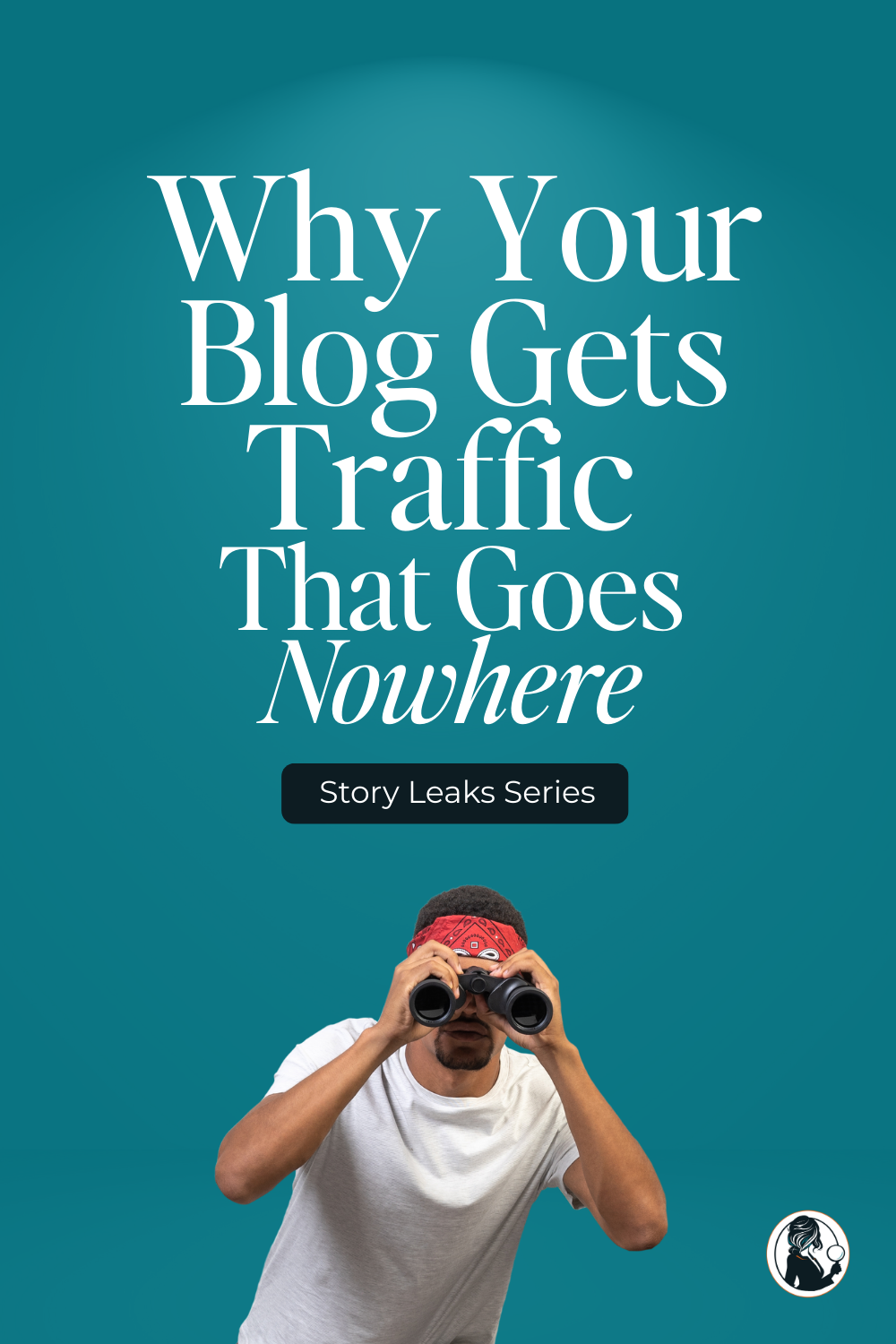
Why Your Blog Gets Traffic That Goes Nowhere
A blog post can do everything “right” and still do nothing for your business. The writing can be strong. The ideas can be sharp. The SEO can be working overtime. Traffic starts rolling in. You check your analytics. You feel briefly accomplished.
And then… nothing happens.
No leads. No clicks. No movement.
If your blog is getting views but not creating momentum, you haven’t built an asset. You’ve built a very polite digital waiting room.
Welcome to another story leak.
The Story Leak Series is where I take apart real funnels, brands, and content systems to find where the story stops working. If you want more of these, subscribe to my Making of a Storyteller Brand newsletter here.
What a Blog Post is Supposed To Do
Here’s where many business blogs go off the rails:
Somewhere along the way, “write helpful content” got confused with “publish things and hope they work.” So blogs became places to think out loud, share insights, and prove you’re smart, without ever being connected to what the business actually needs.
A business blog is not a creative writing exercise. It’s not a thought dump. It’s not something you publish “for consistency.” A blog post exists to move someone closer to a decision.
That decision might be small. It might be early. It might be exploratory. But it should exist.
If the only outcome is “That was nice,” you’re not building a system. You’re entertaining strangers. Which is fine if you’re running a magazine. Less helpful if you’re running a company.
Story Leak #1: Posts That Educate…and Stop
Most underperforming blog posts aren’t bad. They’re clear, helpful, and thoughtful. They explain something well, close with a neat summary, and send the reader back into the internet with no direction.
So the reader thinks, “That was useful,” and immediately forgets where they read it. Not because they didn’t like you. Because nothing invited them to stay.
Story Leak #1 Check
When someone finishes your post, is the next step obvious without scrolling back up and hunting for it? If not, the story stalled.
Story Leak #2: The “Job” Was Never Assigned
Every piece of content needs a job. Not “educate.” Not “add value.” Not “build authority.” Those are table stakes. The real question is what this post is responsible for doing inside your system.
- Is it supposed to warm someone up?
- Move them deeper?
- Qualify them?
- Prepare them to buy?
If you can’t answer that clearly, the post is unsupervised. It’s doing its best. It just doesn’t know what it’s supposed to be doing.
Story Leak #2 Check
Can you explain this post’s role in one sentence? If not, it doesn’t have one yet.
Story Leak #3: CTAs that Don’t Match The Moment
This is where most “dead-end” blogs actually break. You’ve earned attention. You’ve built trust. They’ve even read the darn thing. And then the CTA shows up like it wandered in from another website.
- “Book a call” after an introductory post.
- “Buy now” after a how-to.
- “Join my program” before you’ve explained why it exists.
Or worse, nothing at all.
A CTA isn’t a sales button. It’s a handoff. A page turn to the next chapter. It’s how you carry the story forward. When it doesn’t match the reader’s mental state, they ignore it. Not out of resistance. Out of confusion. You need to TELL them the next step, but make it one that makes sense for them (not you.)
Story Leak #3 Check
Does your CTA reflect what the reader is actually ready for at that point in the story? If not, momentum leaks.
Story Leak #4: Your Topics Have Nothing To Do With What You Sell or Offer
This one is uncomfortable, so people tend to skip it. But I’ve seen this first hand, I’ve had to try to map broken topics to a story and system that just didn’t’ work before.
Some founders write about whatever they are interested in, what they are passionate about.
Personal interests.
Random opinions.
Broad “thought leadership.”
Overly dense topics that don’t solve a product problem.
Things they enjoy talking about.
And when someone points out that none of it connects to their actual offer, the response is usually some version of:
“I don’t want to box myself in.”
“My audience will figure it out.”
“If they don’t like it, they’re not my people.”
Sure, it sounds confident. It’s actually avoidance.
Because this is reality: if your content never connects to the problem you solve, your audience has no reason to associate you with solving it.
You’re building familiarity, not relevance.
People may like you.
They may enjoy reading you.
They may even look forward to your posts.
And still never think of you when they need what you sell. That’s the biggest story leak.
Story Leak #4 Check
Can your customer (NOT you) draw a clear line from this post to your offer without mental gymnastics? If not, the story is drifting.
Why This keeps happening
When blogs go nowhere, it’s rarely because of traffic or talent. It’s because they’re built as standalone pieces instead of chapters.
Each post lives on its own island. There’s no narrative thread, no progression, and no shared direction. Readers drift in and out without ever feeling like they’re going somewhere.
Your audience isn’t consuming content in isolation. They’re forming a story about you. What you focus on. How you think. Whether you understand their situation. Whether you’re worth listening to.
When your content doesn’t connect, that story stays fuzzy. And fuzzy doesn’t convert.
Your quiz funnel is one chapter in that story. If the foundation underneath it is strong, every step reinforces the same message and the next step feels obvious. If the foundation is shaky, the quiz can’t carry the whole relationship by itself, and that’s when the leaks show up
How To Find (And Fix) Your Story Leaks
Open one of your recent posts and read it like you’ve never seen your brand before. Notice where you start nodding. Notice where you feel engaged. Notice where you think, “Okay… and?”
That “and?” is the leak. Not the bounce rate. The moment of lost momentum.
To start fixing them, focus on role clarity.
You don’t need to scrap all your blog content. You need role clarity.
For every post, write one sentence:
“This post exists to ___.”
“This CTA exists to ___.”
“This offer exists to ___.”
If you can’t finish the sentence, that’s your starting point. Then rebuild around that purpose.
And if you’ve read a few of these Story Leaks, you’re sensing a theme, aren’t you? 🙂 Because content has a job to do. But more than that, it belongs inside a larger story. When you assign roles, the story holds. When you don’t, your blog becomes a collection of nice thoughts with nowhere to go.
A blog post is never “just a blog post.” It’s one moment in how someone learns to trust you. One data point in how they decide whether you’re relevant. One signal in whether your brand feels coherent.
The brands that last aren’t better at tactics. They’ve built a foundation story that holds no matter where the customer meets them.
When that foundation is strong, every post reinforces it. When it isn’t, even great writing goes nowhere.
And if you’re thinking, “I’m too close to this to know where it’s breaking,” that’s normal. It’s also exactly why I look for story leaks as part of Foundation Story work—so the story stays intact no matter where someone meets you.
The Story Leaks Series is where I take apart real funnels, brands, and content systems to find where the story stops working. Not because the tactics are wrong, but because somewhere along the way, a step forgot its role (or never had one).
Content has a job to do. But more than that, it belongs inside a larger story. When you don’t know where it fits, people don’t know where to go.
If you aren’t sure what story your marketing is telling, a Foundation Story Audit is the place to start.