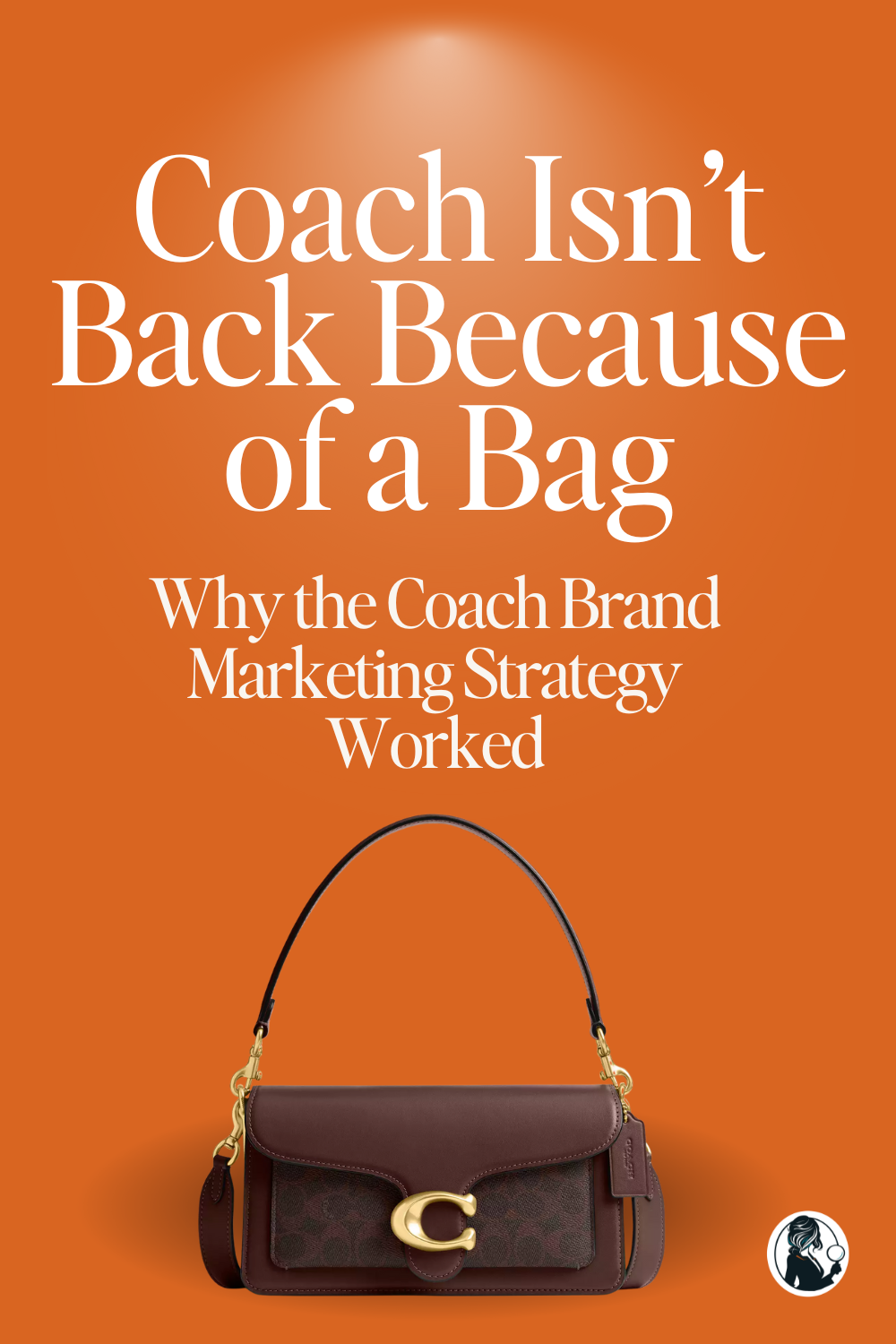
Coach isn’t back because of a bag
Coach is back in the conversation. But most coverage of the Coach brand marketing strategy misses the real story.
Not quietly. Not accidentally. And not in a way that feels fragile.
The bags are everywhere again. The charms. The customization. The resale chatter. Physical stores that people actually want to spend time in. Younger buyers arriving without older ones disappearing. Momentum that doesn’t vanish the moment the algorithm moves on. All of that skips the part that actually matters. This comeback didn’t start with a bag.
Here’s the part that should bother you if you build brands for a living.
None of this should be working.
At least not the way it is.
Because every single visible move Coach is making right now is a move other brands have tried—often with bigger budgets, louder campaigns, and more urgency. And for most of them, it fizzled. Or spiked and collapsed. Or worked just long enough to confuse the team into repeating it.
So this isn’t a story about a clever tactic.
It’s a story about something most brands never think to look for.
The Question everyone is asking about Coach’s Marketing Strategy and Why It’s the Wrong One
Most of the commentary around Coach sounds the same:
- They nailed personalization.
- They figured out Gen Z.
- They went viral again.
- They made the right bag at the right time.
Those explanations feel satisfying because they’re neat. They give you something to point at. Something you can screenshot. Something you can pitch internally as “the move.”
But here’s the problem:
If that were the explanation, we’d be seeing a lot more successful comebacks. We’re not.
Which means the real question isn’t what Coach did.
The real question should be:
Why are these moves landing now, when the same kinds of moves usually don’t?
That’s the mystery worth solving.
What’s Obvious Right now
Before we go any deeper, it’s worth grounding this in reality. Coach is not “having a nice moment.” The numbers back this up.
- Gen Z and Millennials now make up over two-thirds of Coach’s new customers in North America.
- The Tabby and Brooklyn bags saw explosive demand.
- Revenue grew 15% in Q3 2025.
- Gross margins hit 77% without relying on discounting.
- Coach surpassed Michael Kors to become the second-largest U.S. luxury handbag brand.
- Stores are up. Visits are up. TikTok is working.
Coach has returned to sustained growth, not a one-quarter spike. Demand is up across categories, not tied to a single hero product. Younger buyers are entering the brand without older customers quietly falling off, which is rare in a category where relevance is usually traded instead of expanded.
Resale activity has increased, signaling longevity and perceived value rather than trend churn. Repair and circular initiatives aren’t being treated as side projects; they’re being used, which means customers believe the brand is worth keeping in rotation. Physical stores are performing as experiential spaces, not just transactional ones, with dwell time and engagement that suggest people want to be there — not just pass through.
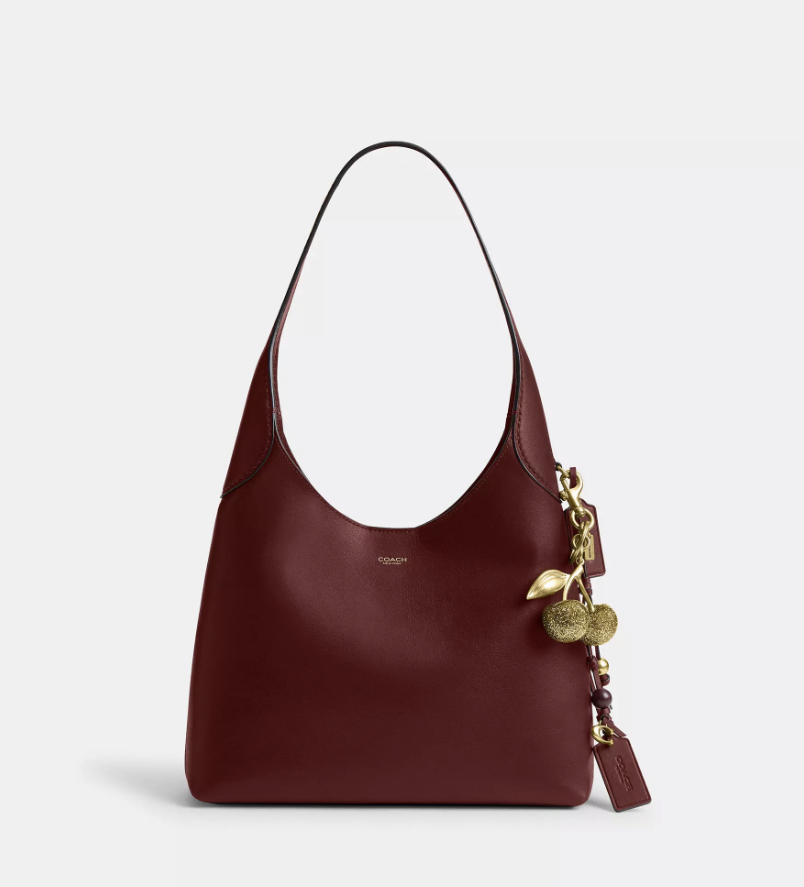
And yes, products like The Brooklyn Bag (below, not an affiliate link, just a pretty one) are highly visible right now. But visibility alone doesn’t explain why this momentum is holding, why it’s compounding instead of burning out, or why it feels steadier than most brand “revivals” we’ve seen over the last decade.
Those outcomes tell us something important:
This isn’t a fluke.
It isn’t fragile.
And it isn’t being propped up by one smart move.
From the outside, this looks like a smart Coach marketing strategy.
From the inside, it’s something much deeper.
I’ll also add this: Coach caught my attention long before I started researching their viral moments or pulling their numbers. I’ve carried Coach bags for years. (I own exactly two now.) Not as a status signal, but because I love how I feel when I hold them. They’ve always felt lived-in, beautifully made, steady, like they belong in my real life.
And almost a decade ago, Coach did something that quietly changed how I think about storytelling for brands. I shared that moment in Issue 001 of my newsletter here.
Which brings us back to the mystery.
Stop Looking at The Tactics
If you only look at tactics, you miss why this worked.
Tactics are the easiest part to see. They’re also the least reliable part to copy.
Bags go viral every day. Pop-ups happen constantly. Customization isn’t new. TikTok doesn’t magically create long-term demand. Most of the time, those things create noise, not momentum.
So when all of those pieces suddenly do work together—across channels, across generations, across time—it’s not because the tactics were smarter. It’s because the brand underneath them stopped fighting itself.
All of the reporting around Coach is correct. The growth, the demographics, the product hits. What those explanations don’t account for is why these moves didn’t work against each other the way they often do.
That answer lives underneath the tactics, in the structure holding them together.
And that’s where most brands lose the plot.
The Blind Spot That Makes This Look Like Luck (When It Isn’t)
Here’s the blind spot I see over and over again when brands study moments like this. They analyze the output instead of the structure. They study the surface instead of the system.
They ask:
- What campaign drove this?
- What platform mattered most?
- What product unlocked the moment?
Those questions assume the brand is a collection of parts. It isn’t. A brand is a sequence of experiences that either reinforce each other—or quietly cancel each other out. And that sequence shows itself most clearly when a customer has a choice.
- Scroll past or stop.
- Walk in or keep going.
- Pick it up or put it back.
- Buy now, buy later, or don’t buy at all.
If those moments don’t line up emotionally, cognitively, and behaviorally, no amount of good tactics can save you. Coach rebuilt that alignment. That’s why this doesn’t feel like a flash.
Coach Fixed The Structure, Not the Surface
Coach didn’t fix a campaign.
They didn’t chase a channel.
They didn’t reverse-engineer a viral moment.
They rebuilt the underlying structure that moves someone from first impression to understanding, from understanding to comfort, from comfort to choice, and from choice to loyalty. Once that structure was holding, the tactics stopped working against each other.
They started working together. That’s why this feels different. And now we can actually break it down.
The Lens That Explains Why this is Working
To understand why these results are holding, you have to stop looking at Coach as a collection of tactics and start looking at it as a system of experiences. This is the lens I use when I’m diagnosing brands, especially when something is clearly working and the usual explanations don’t add up. This is the difference between a surface-level brand marketing strategy and one that actually holds over time.
I’m not asking:
- Which campaign drove this?
- Which platform mattered most?
- Which product unlocked the moment?
I’m asking something else entirely:
- What does the brand make people feel before they think? (STORY)
- Does the brand make sense without explanation? (MEANING)
- Who feels they belong here — and who doesn’t feel judged? (BELONGING)
- What actually changes in behavior because this brand exists? (CHANGE)
Those four forces always move in sequence.
They build on each other.
And when one is weak, the whole system compensates — usually with louder tactics.
Coach rebuilt that sequence deliberately. And once that structure was holding, the tactics stopped fighting each other and started stacking.
That’s what we’re about to break down.
STORY: Coach Rebuilt the Emotional Engine First
Every brand has an emotional engine, whether it’s intentional or not. It’s the thing people feel before they can explain why. When brands stall, it’s almost never because they “ran out of ideas.” It’s because that emotional engine stopped pulling.
Coach didn’t reinvent who they were. They stopped drifting away from it.
The emotional promise underneath Coach right now isn’t aspiration or edge or status signaling. It’s recognition. The products feel like they’re meant to be lived with. The leather doesn’t feel precious. The silhouettes aren’t trying to shock you. Nothing is yelling for validation.
That’s not accidental. It’s a belief decision.
Coach re-centered the idea that quality should fit real life, that style doesn’t need permission, and that confidence doesn’t require intimidation. When that belief came back into focus, the brand stopped performing and started recognizing the customer again.
That matters because emotion is the entry point. If people don’t feel seen, nothing else downstream holds. You can’t explain your way out of a flat emotional signal.
Coach fixed that first.
MEANING: They Made the Brand Easy to Understand Again
Emotion pulls people in. Meaning is what keeps them from bouncing.
Meaning is the layer where a brand becomes legible. Where someone can quickly answer, “What is this brand actually for?” without needing a deck, a manifesto, or a paragraph of justification.
Coach’s comeback works because the brand makes sense again.
There’s restraint in the design. Consistency in the tone. Confidence in what they’re not trying to be. You don’t need context to understand the intention. You don’t have to decode it. The brand isn’t fighting itself across channels.
That clarity is doing a lot of invisible work. When meaning is stable, customers don’t have to exert energy to understand the brand. Decisions feel easier. Trust builds faster. The experience stops feeling fragile.
This is why visibility doesn’t break Coach right now. It strengthens it. The brand can handle attention because the meaning underneath doesn’t wobble when more people look at it.
Coach didn’t explain itself better. They made themselves easier to understand.
BELONGING: They Built Permission, Not Aspiration
This is where most brands get it wrong when they chase relevance. They narrow the doorway. They signal harder. They decide who the brand is “for” and quietly exclude everyone else.
Coach did the opposite.
Belonging here doesn’t require you to upgrade your identity. You don’t need to be younger, cooler, or fluent in a certain aesthetic language. You don’t need to perform taste.
That’s why personalization works here. It’s not novelty. It’s permission.
The same bag can show up in very different lives without the brand correcting the choice. The styling isn’t policed. The customer isn’t forced into one narrow version of “right.”
That creates a powerful belonging loop: people like me choose this. Not because the brand told them to—but because the brand made room for them to arrive as they are.
This is also why Coach can appeal across generations without turning into nostalgia cosplay or trend chasing. Belonging here is comfortable, not aspirational. And comfort is sticky.
CHANGE: The Comeback isn’t Excitement. It’s a Shift in Behavior.
Change is the layer that tells you whether the story is actually working.
Coach’s change isn’t hype. It’s relief.
Relief from trend anxiety. Relief from constant comparison. Relief from performative buying. Relief from the feeling that you have to keep replacing yourself to keep up.
You can see that relief in how people behave. Bags are kept longer. Resale interest rises. Repair and circular programs feel aligned with the brand instead of bolted on. Engagement doesn’t rely on artificial urgency.
That’s what real change looks like. A different relationship between the customer and the brand. A quieter confidence. A sense of “this fits, and I’m done searching.”
When a brand reaches this layer, tactics stop carrying the load. They amplify what’s already true instead of trying to manufacture momentum.
What Coach Rebuilt Underneath All of This
Coach didn’t win because of a bag, a charm, or a platform. Those are just the visible pieces.
This worked because Coach rebuilt the underlying structure that moves someone through a sequence:
- Feel something.
- Understand what this brand is.
- Feel comfortable belonging here.
- Become someone who chooses it again.
That sequence has to hold everywhere—online, in-store, on resale, in culture, in memory—especially at the moment of choice. That’s the infrastructure most brands never look for. And it’s why this doesn’t feel like luck.
Why Copying Tactics Misses the Point
You can copy the pop-ups. You can copy the charms. You can chase your own “viral bag.”
What you can’t shortcut is the structure that makes those things accumulate instead of cancel each other out. Without that foundation underneath, tactics spike and disappear. Teams mistake noise for progress. Momentum collapses as soon as attention shifts.
This is why copying Coach’s brand marketing strategy at the tactic level almost always fails.
Coach didn’t get better at tactics.
They got aligned underneath them.
The One Thing to Take..
Here’s the thing to take with you—not just about Coach, but about any brand moment you’re watching right now:
The brands that last aren’t better at tactics. They’ve built a foundation story that holds no matter where the customer meets them.
Coach didn’t come back because of a bag. The bags are just what became visible once the foundation could finally carry the weight.