Your Brand Needs a Line People Can Cross
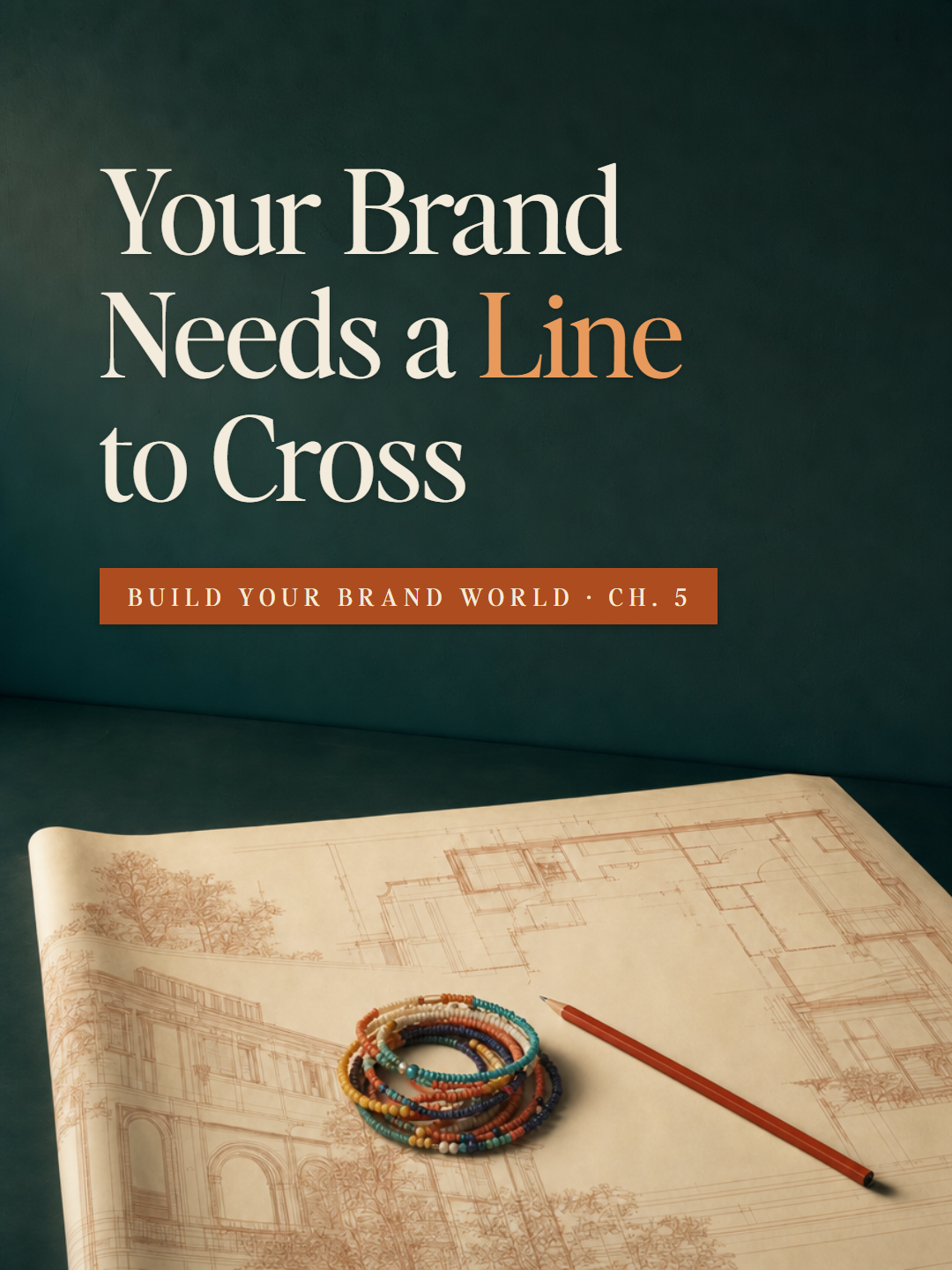
The strongest brands make the shift from “before” to “after” clear enough to become part of someone’s identity.
In this chapter
- Identity Begins When Someone Claims a Side
- You Have to Draw the Line Before They Can Cross It
- Identity Makes Decisions Easier
- Look for the Moment Someone Starts Saying “I Am”
- Neutral Brands Give People Nothing to Claim
- Draw the Before-and-After Line
- If There’s No Line, There’s Nothing to Cross
There’s a moment in every story that changes everything.
And once it happens, it becomes the hinge between before and after. Nothing moves the same way again. The brands and stories that actually change people don’t stumble into that moment. They build it on purpose.
That’s what we’re uncovering today.
If you’ve ever once thought, “Accountants are boring,” I’d challenge you to attend an accounting conference.
One of my first years attending one, I worked for the company that put it on. The last night was the big members’ banquet.
Everyone in full costume.
This wasn’t rogue behavior. It was an annual ritual. The costumes got more outlandish every year.
There’s something wildly satisfying about watching a room full of brilliant adults show up in full creative mode. Everyone took their costumes (and the contest at the end of the night) very seriously.
Me?
I had mine picked out early.
It wasn’t going to win any contests, but it would do something: draw a line on the ground.
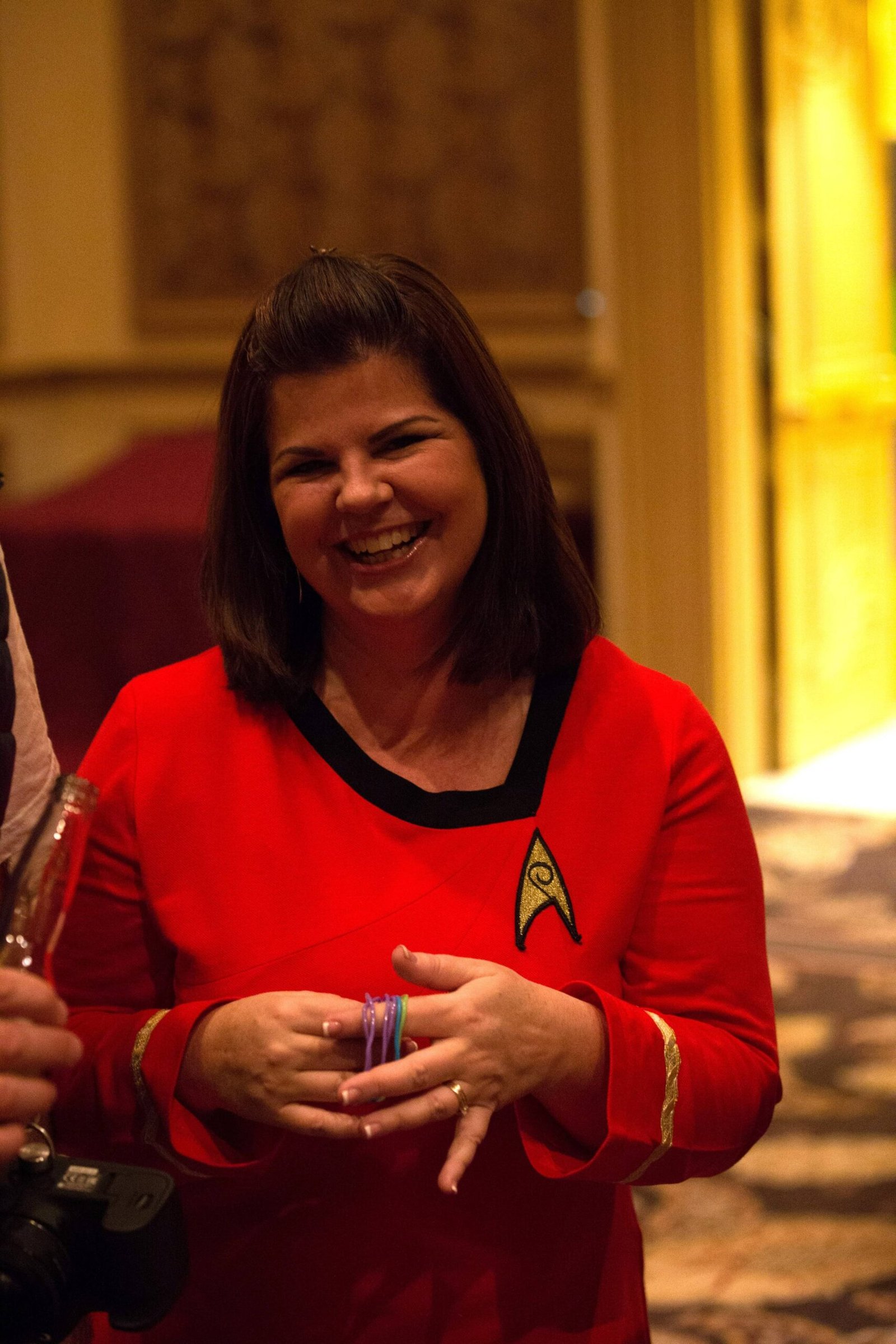
Yup… that’s a Star Trek uniform right there. Red shirt and all.
(I’ll explain that later.)
Halfway through the night, someone looked at me and said, “So you’re a Star Trek fan.”
Without thinking, I answered:
“Yup, I’m a Trekkie.”
I didn’t realize it at the time, but that answer would stick with me.
Identity Begins When Someone Claims a Side
Trekkie is not the same as “fan.”
It covers a wide spectrum of behavior. It can mean someone who’s seen every episode. (Me. Hi.) Or someone who shows up at Comic Con in full prosthetics. Or someone who can speak full Klingon.
It’s one word. But it carries a whole world with it.
The second you say the word out loud, you’re not just describing what you enjoy. You’re placing yourself inside that world. You’re aligning with the standards, the meaning behind the name.
You’re signaling where you stand.
Now, Star Trek might not be your thing.
Maybe you’re a Swiftie.
Maybe you’re a Potterhead.
Or a sneakerhead.
Or a Googler.
Or part of the Bills Mafia.
Or deep in Bachelor Nation.
or a Tar Heel through and through.
(Go Tar Heels! My son goes there, it’s required.)
Different industries. Different energies. Different worlds.
But it’s the same move every time. At some point, it stops being something you like and it becomes something you claim.
Now let’s flip this to you:
This doesn’t just happen in pop culture. And it isn’t always a nickname.
There’s a moment in every story we love and in every brand that actually changes people, where it stops being optional and starts being personal.
Not ‘I enjoy this.”
But, “I am this.”
When someone claims a name, it’s not subtle. It’s a seismic shift.
They’re not just consuming anymore. They’re inside. And that changes how they behave.
Swifties don’t just stream music. They defend eras. They decode lyrics like literary scholars. They trade friendship bracelets with strangers and walk away feeling like they belong to something bigger than a playlist.
Bills Mafia doesn’t just watch football. They show up in freezing weather painted head to toe, jump through tables (yes, through), and donate to causes that matter to their team. It’s loud. It’s loyal. It’s unmistakable.
This kind of behavior doesn’t come from mild interest.
It comes from identity.
And identity changes what people are willing to do.
When someone hires you, reads your work or content, or joins your program, there’s a version of them who is mildly interested. And there’s a version of them who claims something about themselves because of you.
That version behaves differently.
They refer more.
They defend more.
They stay longer.
They show up more fully.
That’s the audience side. But here’s the part that’s easy to forget:
They can’t claim anything if you don’t.
Before someone can step into an identity inside your world, you have to be very clear about who you are inside it. What you stand for. What you stand against.
There are always two identities in play: The one your audience adopts, and the one you operate from.
One can’t exist without the other.
Your audience can’t claim something you haven’t built. They’re not creating a world, they’re stepping into yours. Which means the identity they adopt is only as powerful as the one you’ve claimed first.
If your foundation is vague (I provide services), their claim will be, too. If you haven’t decided who you are inside this story, there’s no world for them to enter.
And if you only define their story (make them the only hero), you flatten yourself.
But when both are clear, that hinge moment isn’t forced. it’s inevitable.
You Have to Draw the Line Before They Can Cross It
Brands that you defend and love build toward that hinge moment. And for that moment to happen, two things have to be true:
Rule #1: You have to claim yours first— and it has to be at the right level.
You can’t ask someone to step inside and become a part of something that isn’t defined. But this is exactly what a lot of businesses and stories try to do. They invite people in before they’ve decided who they are and expect the audience to fill in the gaps.
You have to be clear about who you are inside the story first.
Not your list of tasks. Not your benefits. Not your service menu or your genre or your industry.
Your position. Your standard. Your point of view.
And the level of that matters.
If you claim something safe or vague, something that sounds like everyone else, there isn’t a powerful enough call for someone else to move toward. The identity won’t hold if the foundation is soft.
But when you claim something specific, with edge, with purpose, with a signal that declares how you see the world and what you refuse to compromise on, people can align with you or against you.
That’s the line the hinge moment is built on.
There is no neutral zone.
(Sorry, I had to bring Star Trek back in somewhere.)
Rule #2: There have to be sides, and you have to name them.
Every hinge moment marks a shift. A before and an after, a change with purpose.
In a story, that shift isn’t accidental. The character chooses the call to adventure and moves from one identity to another. Outside to insider. Hesitant to committed. Small to leading the room. And we can name both sides of that line.
Brands work the same way.
Once you know what you stand for, you also have to be clear about what someone is stepping into. What changes for them because of you. Who they become on the other side of that claim.
It doesn’t have to be a cute nickname that ends in “-ie” or “-nation.”
But it does have to be nameable.
If someone can’t describe the shift, they can’t step into it. If they aren’t clear about the difference between who they were before and who they are after, the hinge never locks.
The strongest brands make the sides visible. They make the movement clear. They give language to the transformation. That’s identity forming.
And identity changes how the brain processes everything that comes next.
Identity Makes Decisions Easier
Your brain doesn’t want to work harder than it has to. When it’s faced with options, it looks for the fastest way to decide. (In the brain science department, it’s called Cognitive Miser Theory, which sounds like a grumpy Victorian uncle, and I love it.)
If you’re presenting yourself as a set of services or features, the brain evaluates you the way it evaluates anything on a menu. It compares. It ranks. It starts building an internal pro & con list.
That’s work.
So Ol’ Grumpy Miser Brain looks for a shortcut.
And one of the fastest shortcuts available is identity.
Instead of asking, “Is this the best option?”, it asks, “Is this me?” Or even more powerful, “Is that who I want to become?”
That question is much easier to answer.
Picture this. You’re an accounting firm, and a potential client lands on your site.
In one version, they’re staring at the list of seven services to choose from and wondering which one they need and how to be sure they aren’t choosing wrong
In another version, the message is clear: If I choose this one service option, I stop living in the dark about my finances and become the kind of business owner who makes smart decisions.
The second one is a clear identity marker.
Choice made.
And to be clear, not everyone will choose it. The right people will.
This is where Social Identity Theory comes in. We define ourselves by the groups we belong to, and then we behave in ways that keep us aligned with that group. It reduces friction.
It gives Ol’ Grumpy Miser an easy path forward.
I Stopped Thinking of Brands as Neutral Ground
If you’re not a Trekkie, the Neutral Zone is an uninhabited buffer area in space that separates rival worlds to keep the peace. Cross it, and you’re not just wandering. You’re choosing a side.
And it taught me one thing: when it comes to building stories or brands, there can’t be a neutral zone. There has to be a hinge where identity is either discarded or chosen.
If I’m a Trekkie, I’ll greet you like Spock and happily debate which Captain was the best. (Picard, all day long.)
If you’re a Swiftie and the only way to see her in concert is to fly across the world, that cost doesn’t feel ridiculous. It feels necessary.
If someone sees themselves as a smart business owner who doesn’t want to be in the dark about their finances, they’ll make decisions that reinforce that identity.
Hinge moments can happen at any time.
But they don’t happen at all if the person building the world hasn’t chosen their side first. If you’re still operating from “I offer these services” instead of “This is who I am and what I stand for,” there’s no line for someone else to cross over and join you.
Your identity as the writer.
As the brand.
As the one leading the room.
That’s the first line drawn. And every hinge moment after that depends on it.
Look for the Moment Someone Starts Saying “I Am”
We pay a lot of attention to the moment someone clicks to buy. But the hinge moments come before that.
It’s not the click.
It’s the moment when they identify.
If you start looking for these, you’ll find them everywhere. Sports fans who introduce themselves as Tar Heels or Bills Mafia. Novels where a character steps into the call for adventure. Even employees of companies who adopt a nickname as an act of belonging.
When you look, you can find the before & after.
And then there’s the red shirt.
Star Trek fans know. There is always a crew member in a red shirt that goes out on away missions. We never learn their name. They don’t claim anything. They hover in the background— and they’re the first ones gone. Every time.
And yup, I wore the red shirt on purpose.
Trekkies would get the joke without me ever saying a word.
The red shirt is the complete absence of a line drawn.
You’ll find brands that never define anything or claim anything. They live in the background— and when they’re gone, you don’t notice.
Neutral Brands Give People Nothing to Claim
I know what you’re saying inside (because I’ve heard it from clients, too).
Claiming a side feels risky. Building an identity that you know will push some people away feels like a challenge.
For experts who’ve built a solid business based on what they know and how they work, it can even feel arrogant. You’ve spent years building your credibility, and the last thing you want to do is feel polarizing.
So you stay in task language. You describe your services in detail. It feels responsible to add more. But more doesn’t build identity, it builds confusion.
And it shows up in writing all the time.
If you’re crafting fiction, it’s easy to be soft on your characters. You avoid giving them edges. You hesitate to push them into hard choices. You keep them likable instead of decisive.
If you’re writing content, it stays safe. Your perspective and experience stay hidden, and what shows up are the lessons and the “5 tips.”
Identity requires a line to be drawn.
Without it, there is no hinge moment. No before and after.
Just options. And options…are work.
Draw the Before-and-After Line
Don’t rewrite your website.
Don’t add another service.
Don’t scratch all your writing and start over.
Draw a line.
Seriously. Go grab a piece of paper and draw an actual line down the middle.
On one side, write Before.
On the other side, write After.
Now answer this:
Before working with me (or reading my work), they are the kind of person who ______.
After working with me (or stepping into my world), they are the kind of person who ______.
Not what they have. Not what they get. (Do not list accounting services here.) Who they are.
Then flip it.
Before I claim my identity, I describe myself as ______.
After I claim it, I am the kind of ______ who ______.
Read your answers back.
If the two sides don’t feel meaningfully different, the hinge isn’t clear yet.
If the “after” could apply to ten other businesses, raise the level.
If it doesn’t make at least one person think, “That’s not me,” you’re probably still standing in the Neutral Zone.
You don’t need a nickname. (Though they are a lovely shortcut for Ol’ Grumpy Miser.)
You need a line.
If There’s No Line, There’s Nothing to Cross
You don’t need more.
You need a line someone can cross.
The Cold Brand Read · Free to start
Before you fix the wrong thing, let me read what’s there.
Send me your site. I’ll show you what it’s saying about you, and what it’s leaving out.
Or take the Story Compass quiz